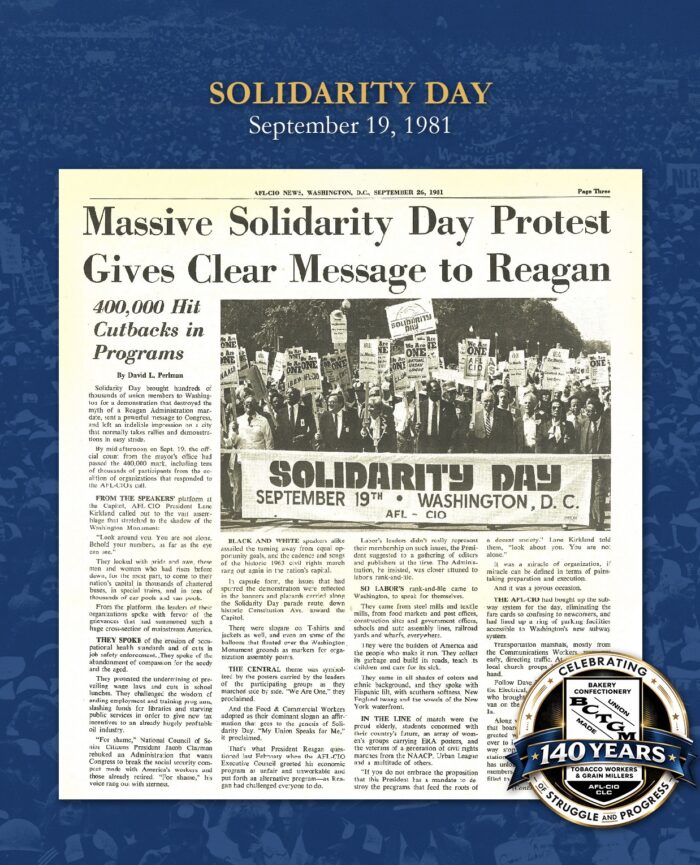
Solidarity Day 1981 was a massive labor demonstration largely galvanized by the strike and firing of the Professional Air Traffic Controllers (PATCO).
Earlier that year, more than 11,000 air traffic controllers—federal employees responsible for the safety of the nation’s skies—walked off the job citing exhausting hours, unsafe working conditions, and outdated equipment. When President Ronald Reagan declared the strike illegal and fired those workers en masse, it sent a shockwave through the labor movement. For many, it wasn’t just about one union—it was a signal that the federal government was willing to take an aggressive stance against organized labor as a whole.
At the same time, the Reagan administration was advancing a broader set of economic policies—often referred to as “Reaganomics”—that included deregulation of key industries, deep cuts to social programs, and a weakening of labor protections. Union leaders and rank-and-file members alike saw these moves as part of a larger effort to tilt the balance of power toward corporations and away from working people.
In response, more than 400,000 workers gathered in Washington, D.C. for Solidarity Day, united in defense of collective bargaining rights, fair wages, and safe working conditions. It became one of the largest labor demonstrations in U.S. history—a moment of both protest and solidarity across industries.
The BCTGM was there, as told by former leaders in these videos. Our late Organizing Director John Price describes the climate on the ground at that time, and retired International President Frank Hurt talks about how the anti-union policies of the Reagan era altered collective bargaining for the long term.